

Port of Yamba Historical Society

winter
26
newsletter

page 1

We acknowledge the Yaegl people as the traditional custodians of the land on which Yamba Museum is located and recognise their continuing connection to Country. We pay respect to Yaegl Elders past, present and emerging.
_edited.jpg)
Greetings and welcome to winter, as well as to the latest edition of the Yamba Historical Society newsletter. As the cold months settle in, we invite you to unwind while we bring you the latest updates, events and historical insights from our society. Expect fascinating stories, important dates and upcoming activities. We hope you find this newsletter enjoyable and informative.
President's Report
Accessibility
Following her attendance at a CV Council workshop in March, our Marketing/Publicity coordinator Gai Pritchett compiled a checklist of items for the Committee to consider to improve access to Yamba Museum for everyone in the community. This is part of a region-wide focus on inclusive tourism focus – to provide equal and dignified access for all wishing to visit and stay in our to Clarence Valley. Data shows that 1 in 5 domestic trips now have access as a requirement and 24 per cent of international visitors have accessibility needs. As well, accessible travellers take frequent, longer trips and spend approx. 20% more per visit.
Our website designer Denise Patten has started to create a new tab called Accessibility. With Gai’s involvement, this site will have clear statements about what our Society offers to visitors who may have permanent or temporary access issues. This website will include photos, measurements and contact details, for example, the distance of the carpark from the museum entry, with photos showing the width of the path; photos of the toilet facility; photos of two designated quiet spaces, with signage; our evacuation map and a drone view of our precinct grounds, organised by Tim Pritchett.
Member Sally Huxtable has been gracious in allowing herself to be photographed using her own walking supports to model how the museum can be easily accessed using the concrete ramp and getting through the front door. We’ve also purchased two new coloured doormats (rich green and bright blue) in preference to heavy black. Neurodiverse child visitors will soon have access to sensory bags, fidget toys and disposable earplugs. We’re also checking our interior spaces for spacing and that our signs are easily visible for everyone. As well, we’re in the process of getting a collapsible wheelchair for temporary use if required – a donation would be most welcomed;
The School Room
We have created a whole new display in the area where numerous files used to be stored – The School Room. We’ve transferred all the objects and prints of school photos from their previous location and with Susan Ong’s creativity, the new space is now filled with school-related memorabilia. It now replicates to some extent a classroom but does not include a blackboard or chalk!
We’d love to add more old-school objects – textbooks, handwritten class workbooks, reports, writing implements, pencil cases, uniforms, school bags etc. If you have or know of anyone who does have anything relevant, please consider making a donation – just drop into the museum during opening hours (Tuesday / Wednesday / Thursday / Saturday / Sunday 10am-2pm) and the front desk volunteers will assist you.
Yamba PS Visit on Thursday 30 April - 85 students in Stage 2 visited in 3 different groups , with each group spending 1 hour at the museum. They were accompanied by their teachers and the principal also came with the first group.
The students had specific areas of their curriculum to find out about - changes in telecommunications and school classroom conditions and learning; the development of Yamba over decades.
Trish Bowes coordinated the very successful visit, creating a 4 -page worksheet for students to complete back at school and organising the volunteer guides .
Many thanks to member Robert Lee for his two outstanding historical talks on North Coast Railway and Shipping History. Robert was well prepared with a powerpoint presentation consisting of many slides easily read by the attentive audience.
I learnt lots at the second talk about the many possibilities and politics around building railway lines in the Northern Rivers; that the Clarence Bridge opened in the same year as the Sydney Harbour Bridge, 1932; about a decision to build a deep seaport at Iluka in 1952; that I should visit two historic sites: Bawden Bridge before it’s refurbished by NSW Transport; Yester Grange Estate in Wentworth Falls, the home of former NSW Premier John See in 1901-1904, with its stunning view over the Jamison Valley; that I should make the Kyogle to Glen Innes rail trip.
Robert will repeat these two talks later in the year- this time in the Old Kirk:
Thursday 3 September, at 11am following 10.30am morning tea
Thursday 15 October, at 11am following 10.30am morning tea


Committee Members 2025 - 26
President Lesley Pickering ... Vice President Brenda Salisbury ... Treasurer Kerry Hulm
Committee Members
Jan Angelo ... Sue Hughes ... Margaret Lawrence ... Jude McBean
Robert Lee - History Talks

.jpeg)
Robert Lee’s fascinating history talks covered the development and growth of transportation in NSW and our area in particular. Roberts brilliance set the stage, correlated and delivered the story in a thoroughly comprehensive and amusing tale.
Yamba was in the thick of the transport action during the early years of settlement and through the war years. There are lots of myths about transport and Robert sets you straight on many of them. An experienced orator Robert has researched this history for many years as his main interest.
"The second talk was rather different. The first talk was on the wider context of railway development in eastern Australia. The second talk was a more regional and local emphasis and looks at what happened in the North Coast region and specifically the Clarence. It was on shipping, harbour works and railways and the driving forces behind them. It also touched on the origins of the Country Party and the New State Movement for political context."
Robert will deliver both talks again:
Thursday 3 September, at 11am following 10.30am morning tea
Thursday 15 October, at 11am following 10.30am morning tea


Back Then ...
.jpg)
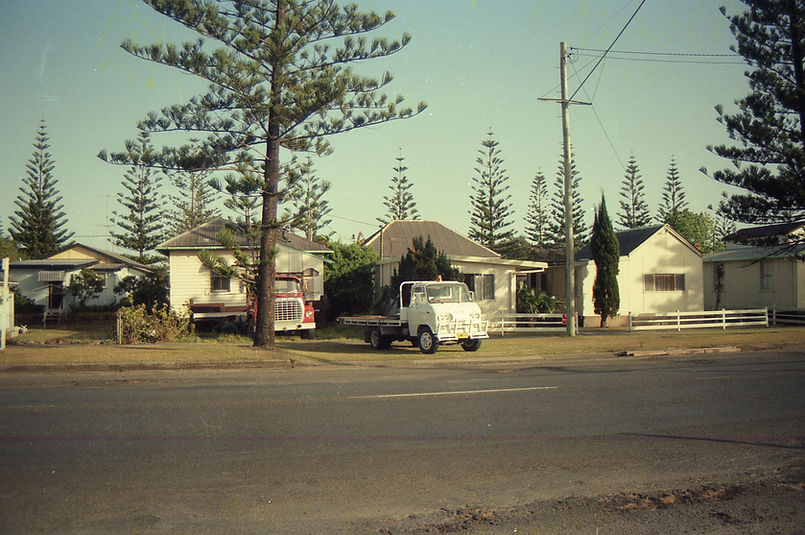
As building development expanded in the Yamba CBD, many of the old buildings were demolished to be replaced by modern structures. Others were removed to new locations and refurbished.
This photograph, probably taken in late 1992, shows one example of a building that was located at what is now Number 11 Harbour Street. We see the rear view of the building here on the back of a truck after having been moved from its position on the Harbour Street frontage, ready to be taken off into Wooli Street. The Norfolk Pine in front of the block meant that the truck had to turn left into Wooli Street followed by a right turn into Yamba Street before making its way out of the CBD. The photograph is one of a series of six taken on the day of removal.
With the exception of the building with the yellow gable at the left rear of this photograph, all of the buildings that can be seen here were either removed or demolished within the next decade or so. This includes the two storey structure that can be seen on the extreme right rear of the photograph which was located at the corner of Yamba and Harbour Streets and is now the site of the three level structure at Number 1 Yamba Street, next to the Spar Service Station. The taller building with the hipped roof in the background behind the white flattop truck was the old Bayview Boarding House which was demolished in about 2003. The blocks between Number 11 Harbour Street and the buildings mentioned above in Yamba Street are now vacant.
The Bayview Boarding House was a built in 1912 and replaced a boarding house run for many years by Margaret Buchanan on the same site. These buildings were, of course, directly opposite the Public Wharf and next door to the Yamba Hotel. They were central to all the activity coming into and out of Yamba by River Boat Steamers. On 5th October 1895, an article in the Clarence and Richmond Examiner stated that “Mrs Buchanan, whose tender was accepted for providing new postal and telegraphic premises, has erected a comfortable five roomed dwelling, with attached office.” A close examination of historical photographs reveals that the building being removed from Number 11 in this photograph was, in fact, the same building built by Margaret Buchanan.
Small modifications were made to the building in early years. In particular, the offset window and door that can be seen in early photographs on the Harbour Street facade of the building were replaced by a single window that became central to the front wall. Also, a small annex that was added to the building in about 1910 was later removed.
What has happened to the building? Where did it go? The building is still standing today and can be seen at Number 165 Yamba Road.
Rob Knight
14th February 2026
Loss of the Sloop Adinda at Yamba Bar


I was recently contacted by a retired police officer regarding my article “The Big Green Wave – Sea Dreamer Tragedy”, which was published in the Clarence Valley Independent on 14 January 2026.
Sergeant Ron Bloxham was stationed at Yamba when the Sea Dreamer sank and my article brought back memories for him of another drowning at the Yamba Bar on 02 June 1977, which he shared with me.
On 20 May 1977 Roger Stephen Wand set sail from Sydney in his sloop Adinda with the intention of exploring the Great Barrier Reef and seeking further employment. On 02 June he arrived at the entrance to the Clarence River at Yamba and was observed by several persons sailing up and down until late in the afternoon.
At 4.45 pm, he lowered the mainsail and under the power of his 6 hp Evinrude outboard motor, he headed the sloop towards the entrance of the Clarence River. Sea conditions prevailing at the time were moderate. As the sloop approached the Bar area, it had lined up with the ‘leads’, which are plainly visible down the river. This caused the boat to travel across almost the centre of the bar where waves sometimes ‘cap’, especially on the ebb tide. Nevertheless, he persevered and suddenly found himself in a perilous position.
Yamba fisherman Robert Toyer saw the sloop capsize while watching from the hill at Flinders Park. He alerted other fishermen with their trawlers tied up at Yamba Marina and Des Bailey in the Evans River was the first to arrive on the scene of the mishap. By that time the sloop had popped back up to the surface and righted itself.
Another witness who had been watching the incident through binoculars said he plainly saw a person swimming away from the sloop in the direction of the breakwater after it had been hit by the wave.
Crewman of the Evans River, Tom Bushel, boarded the stricken craft. Apparently, the bow anchor had dislodged from its position on the deck and gone to the bottom, effectively mooring it in position. He found no one on board and it was towed into the marina.
Police were now placed with the problem of the missing sailor, with the added possibility that further unknown persons may have been washed overboard. Sydney Water Police verified that the sloop Adinda was owned and skippered by Roger Stephen Wand and that he had sailed from Sydney about two weeks before the incident. Further, that he had no known relatives in Australia. A British Passport and License in Wand’s name were located.
As a result of an appeal by Police concerning the matter, Mr Keleher of Lake Cathie contacted Sergeant Bloxham and stated that Wand was at Laurieton on 27 May 1977 by himself. On 03 June, Bloxham was phoned by Mr. Yeomans of Woolloomooloo, Sydney, who advised he had known Wand for some six years and said he could assist with identification if necessary. He knew Wand’s family lived in Sheerness, Kent, England and police in Kent then informed the parents that he was lost at sea, presumed drowned.
Local beaches, headlands and rocks were searched, until, after some six days, Senior Constable Beaumont of the Harwood Island Police Station recovered the body of a male person on the beach at Iluka on the northern side of the Clarence River. The body was in an advanced state of decomposition, bloated and badly discoloured, and as such ‘positive’ identification could not be established from facial observation.
A water sodden receipt in the name R. Wand issued by Elizabeth Bay Marine Centre for mooring fees was located in a shirt pocket. He was wearing a Coronet diving watch which had stopped at 9.45 on 03 June 1977.
The body was taken to Maclean District Hospital Mortuary where it was completely X-rayed for any ‘old’ fractures or any other features that could assist with identification. Police at this point were satisfied that the body was that of Roger Stephen Wand but still ’positive’ identification had to be established for the Coroner, Gary Hall of Maclean.
When contacted again, Yeoman confirmed that Wand wore a Coronet divers watch similar to the one found. He also suggested that dental charts for Wand might be found as he was once employed as a gardener for the Sydney City Council. Mr Ratcliff, staff dentist at Sydney Town Hall, was contacted. He directed police to the deceased’s private dentist, Mr Regan of South Coogee, who stated he had carried out a ‘large gold filling on the left 6 M.O.D’ which was quite pronounced and could be easily identified. He was able to supply a mouth X-ray from his records.
At 2pm on 09 June 1977 the Coroner, Detective Senior Constable Carl Cameron of the Scientific Investigation Section at Grafton Police and Wayne Hinchcliffe, a local Dental Surgeon of Maclean District Hospital, conducted an examination of the deceased at the hospital Mortuary under the most unpleasant conditions. Fingerprints were taken. Hinchcliffe prized open the mouth of the deceased and carried out a dental examination. He found a ‘large gold inlay filling on the upper left 6 M.O.D’. which he positively identified as identical with the X-ray supplied by Regan.
The Coroner was completely satisfied with the effort and accepted the means of identification.
Wand’s mother was contacted and the body cremated.
John McNamara
Research Officer
Port of Yamba Historical Society
Postcards from the Collection


These postcards of Main Beach in Yamba offer more than scenic views—they’re a glimpse into the town’s early coastal life and evolving identity.
Presented in striking black and white, each image highlights the textures and contrasts of another era, from weathered headlands to the simplicity of the shoreline before modern development.
The first photograph, dating back to 1906, is especially significant, capturing a time when Yamba was still emerging as a seaside destination. Together, the collection traces a quiet history—of changing fashions, shifting landscapes, and the enduring draw of the ocean—preserving moments that continue to shape Yamba’s character today.
RIVER OF LEARNING - Art Show
 |  |  |
|---|---|---|
 |  |
OUR HOME, OUR COUNTRY, OUR RIVER
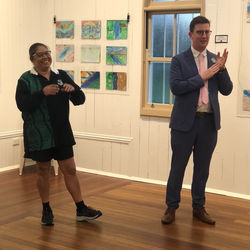
The Old Kirk at Yamba Museum proudly hosts Maclean High School’s Art Show, on now until 9th June. At last Friday evening’s official opening Principal, James Witchard, acknowledged Anjanette Warburton, Aboriginal EducationLearning Officer and Liza Hamilton, Head Teacher Social Sciences, for their tireless dedication to this annual event. An excited gathering of teachers, students and parents were in attendance.
Organisers invite the community to view the artworks and appreciate how the Year 6 students throughout our Yaegl Valley Schools interpreted the theme. The event is part of Maclean High School’s Reconciliation Week celebrations.
This years winners are:
Overall Winner
is Jannat from Maclean Public School.
Iluka Public School – Tilly. Palmers Island Public School – Amara. Harwood Public School- Isaac.
Gulmarrad Public School – Audrey. Lawrence Public School – Lahni. Wooli Public School – Sylvie.
Maclean Public School – Pearl. Chatsworth Island Public School – Ilah. Cowper Public School – Scott.
Yamba Public School – Saphira.
The Gallery is open during Museum hours, Saturday, Sunday, 10am – 2 pm and Tuesday, Wednesday, Thursday 10am – 2pm. Entry $5 for over 15 years which gives access to the museum and the Gallery.
Consider Volunteering ?
Discover what it’s like to volunteer at your museum!
You’ll meet like-minded people, learn new skills, have fun, and build lasting connections in a vibrant, welcoming cultural space. It’s a great opportunity to be part of something meaningful and make a real difference in your community.
You may be interested in helping in the following areas: catering team, collection team, research team, gardening team, or welcoming visitors on the front desk roster - 4 hours per month.
Please email yambamuseumnsw@gmail.com, if you would like to know more and a volunteer member will contact you

Volunteer Week stand at Coles manned by Gai Pritchett, Graeme East, John McNamara, Brenda Salisbury and Mardi Dunbar. Monday 17th & Tuesday 19th May.