

Port of Yamba Historical Society

newsletter
spring


We acknowledge the Yaegl people as the traditional custodians of the land on which Yamba Museum is located and recognise their continuing connection to Country. We pay respect to Yaegl Elders past, present and emerging.
Welcome to the Spring edition of the Port of Yamba Historical Society newsletter! We invite you to sit back and take a moment to relax as we share the latest updates and happenings within our society. Mark your calendars! We have a series of exciting events planned, including tours and community gatherings that celebrate our local history. Thank you for being an integral part of our community. We hope you enjoy this edition of the newsletter and look forward to seeing you at our upcoming events!
President's Report
President’s Report Spring 2026 Issue 27
New Committee 2026/2027
At the August AGM a new Committee was elected for the next financial year 2026/2027. I’m very pleased to welcome two new committee members – Robert Lee as Hon. Secretary, filling a position that had been vacant for quite a while, and Trish Bowes who’s taken on responsibilities as Group Tours Coordinator. Other volunteers’ names will be known to you – please refer to the list below.
It’s always a bonus for the Society to have fresh minds and perspectives in making decisions. Sincere thanks to Anne Dinham who has retired from the Committee after many years serving the Society at the management level.
I’m not able to share a photo of the Committee with you for a few months as two members were absent from the AGM - Suzie Hughes (who is still travelling overseas) and Jude McBean who was in Queensland as part of a group of local artists exhibiting at the Roma festival.
Our very first task is hosting the Chapter Meeting for Far North Coast volunteer museums – members of 23 small organisations like ours will visit on Friday 4 September from 9.30am-3.30pm for upskilling workshops on accessibility, collecting oral histories and succession planning. We gain much from these meetings and enjoy hearing about various in-house exhibitions and collaborations with local communities.
Office bearers
President – Lesley Pickering
Vice President – Brenda Salisbury
Hon. Secretary – Robert Lee
Hon. Treasurer – Kerry Hulm
Committee members
Jan Angelo, Trish Bowes, Suzie Hughes, Margaret Lawrence, Jude McBean.
AGM reports and presentation
Working together with other Society volunteers, the committee will continue researching and designing ways to revitilise the permanent exhibition. This is a long-term project guided by our Museum Advisor Dr Kate Gahan. One visible outcome of expenditure on the revamp will soon be available for visitors to access – the Touchscreen.
The advantages of this digital equipment were highlighted at the AGM by Denise Patten, our communications officer extraordinaire. Denise gave an enthusiastic presentation about the newsletter, website and touchscreen, showing her deep commitment to engaging everyone in what historical collections have to offer. I encourage you to read a copy of Denise’s stimulating talk as well as annual reports from myself, Hon. Treasurer Kerry Hulm, Jan Angelo and Trish Bowes.
There are always small, self-contained jobs to be done at a time to suit you. If you’d like to assist, please contact me via the Society’s email: yambamuseumnsw@gmail.com.
The School Room
As Jan Angelo, Coordinator of the Collection Team, reported at the AGM, we’d love to add more old-school objects to the newly established School Room. So, we’d be very excited to receive any donations if you can put your hands on any old textbooks, handwritten class workbooks, reports, writing implements, pencil cases, uniforms, school bags etc. Just drop into the museum during opening hours (Tues/Wed/Thurs/Sat/Sun 10am-2pm) and the front desk volunteers will assist you in completing the donation form.
Shed Clean Up
Some of you will most likely have noted the pile of discarded and broken items on the verge near the carpark entrance. All that’s left after much taken by passers-by will soon be collected and taken to the Maclean Waster Transfer station. Thanks to the financial generosity of Margaret Lawrence in employing a casual handyman and to Rick Angelo, a few of us spent from 5 to10 hours over three days sorting through everything stored in the shed from the last 15 years. We didn’t use the Swedish Death Cleaning mode but we’ve managed to clear out a substantial amount, thoroughly clean the shed and compactus and create lots more space for more careful storage so that all is easily visible and accessed. Thanks to Brenda Salisbury, Jan Angelo and Kerry Hulm for working with me.
Forthcoming events
I’m sure you’ll take note of all the events that are happening from September onwards – Robert Lee’s two talks; art exhibitions by Ferry Park Gallery’s artists group, Graham Mackie and John Jackson, plus John will give 2 talks about his latest artworks.
Lastly, we’ve planned a special Christmas event for Friday 4 December at Café Marina, 12 noon to celebrate the 45th Birthday of the Society – formed on 20 September 1981. The Society will subsidise the cost of a main meal and dessert for each person attending.
Please diary the date and respond as soon as possible to the November email so we can order your lunch selection.


President's AGM Report
PORT OF YAMBA HISTORICAL SOCIETY - Friday 14th August 2026
Good Morning Members.
This year we have lots to smile about as we celebrate another anniversary - 45 years since our Society formed on 20 September 1981. We’ll acknowledge this at our Christmas function on 4th December – more in the newsletter and email.
This is my 7th report as President after 7 years in the role. I continue to be impressed by the strong sense of care and purpose across our Society.
During the past 12 months there was much that we achieved. And I use the plural personal pronoun “we” sincerely – every member contributed, in a range of ways. All planned projects were completed including the following:
-
Painting the interior of the Old Kirk
-
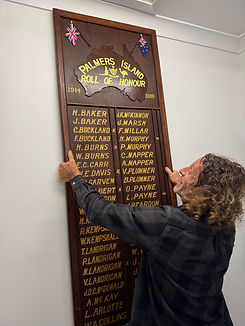
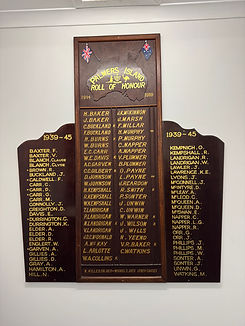
Restoring the War Honour Boards from Palmers Island School, all names from WWI and WWII servicemen are now legible. The boards are hanging on a different wall and will be a feature in the new Military display.
-
Holding a Morning Tea for volunteers - those newly residing in Yamba and thinking about how they can get to know the community, meet new friends.
-
Two history talks in April by Member Robert Lee were very enjoyable and much appreciated by those attending. These talks concerned government policies, proposals and developments of early railway history in Australia. Robert will repeat these talks in September and October.
-
The former File Room was repaired, repainted and established as The School Room, now a popular visitor display.
-
The Revamp of the Permanent Exhibition continued at a steady pace. We met regularly with our Museum Advisor Dr Kate Gahan and this will continue during the remainder of 2026 and throughout 2027. The grant of $5,700 from Museums & Galleries NSW was to fund Kate’s deep research into some of our iconic collection items.
-
Without doubt our most successful event this past year was the fundraiser in January –Bivalves and Bubbles was an overwhelming success that raised just over $4,000 with more than 100 attending and several turned away. The event complemented the exhibition on restoring oyster reefs, developed by the Australian National Maritime Museum, attracting many local visitors. The $4,000 will go towards exhibition equipment and furniture as part of the revamp project.
Our visitor numbers increased a little from last year with a total of 3,176. Of this, Group tours totalled 249 (about 8%) and school groups were 147. I wish to thank Trish Bowes for agreeing to become the Group Tours coordinator in early February. Trish will give a fuller report later. Our four busiest months were on either side of the calendar year – March/April, then October/November, perhaps in line with seniors on the move. The majority of visitors came from NSW (1,586), closely followed by Queensland (1,012) – as expected.
Our membership reached a peak of 151 members. Currently, about 45 members are active volunteers - a truly outstanding effort, particularly when many of them also attend the Annual Volunteer Information Day held in February.
Our financial situation remained healthy. Treasurer Kerry Hulm will present full details later. Kerry continued her consistently high standard of recording and reporting.
The Committee of 8 met every month and shared jobs previously done by the Secretary as this position remained vacant. For upskilling, we attended one Chapter meeting at Alstonville, and Jan Angelo was able to attend the inaugural Volunteers Symposium in Sydney in December. In one month’s time, we’ll host the Far North Coast Chapter Meeting for 23 small volunteer museums. Each Committee member contributed with thoughtful discussion on management issues and decisions, always mindful of our strategic plans and activities, budget and Members. I wish to acknowledge the outstanding service on the committee for many years of Anne Dinham who will retire.
Key volunteers performed their core jobs, keeping the museum open, the Society viable and the community involved.
-
Bev Mansfield organised our monthly roster for the Front Desk
-
Rob Knight managed our 5 databases and IT equipment as well as his research and Image Library work – 12,000 indexed, digitised images!
-
The Collection Team met regularly on Wednesdays - Coordinator Jan Angelo will give a separate report later.
-
Our Venue hire income was secured by the very reliable and professional work of Margaret Lawrence. In summary, in the Old Kirk there were 7 art exhibitions, 2 weddings and 4 back-up weddings, as well as the Regional Principals conference, meeting of the Cane Toads Group and Memorial. There are already 7 art exhibitions, 1 wedding, 4 back-up weddings and 3 history talks booked for 2026-2027 financial year. Our thanks go to support from Melissa and Frank Helwig who hang the artworks for exhibitions.
-
Researcher John McNamara continued compiling the Newspaper index and writing for the local newspaper. He gave a well-received and well-attended talk at the library on his book Yamba Across Two World Wars 1914-1945.
-
Gai Pritchett wrote media releases of Society events in the local newspaper, complemented by Graeme East’s postings on FB. Gai also maintained liaison with the Council re tourism promotion, working with Bev on supplying our Visitor Information stand.
-
Maintenance issues and jobs were brought to our attention by Graham Young, who also arranged for the repair and upgrade of the former File Room.
-
The Garden team lead by Graeme East gave us a welcoming streetscape profile. Thanks to Rex Glencross-Grant for recently spreading free mulch.
-
Vicki Jermyn compiled visitor data and Jude McBean managed the Bookshop.
-
Brenda Salisbury, along with the hospitality team, continued to wow visiting coach groups and those attending events with her catering skills.
-
Lastly, I’d like to expand on the work of Denise Patten who is our guest presenter today. She’s been the cornerstone of our digital communication with members and the community – local, national, international. Denise continued to collate items and improve the design of our digital newsletter (4 times per year), encouraging content items. As well, Denise manages the Society’s website - it’s challenging being up-to-date, of the moment – there’s always something to add/move/remove to make it interesting. And this all requires time. Her third job concerns the Touchscreen, exhibition equipment that we purchased a little while ago and that you’re about to view soon. Denise has spent untold hours getting this ready for use in the museum by visitors.
In sum, I wear my President’s badge with honour and am proud of our achievements, stable governance, and the happy environment that attracts immeasurable volunteer hours. Thankyou.
AGM Hon. Treasurer's Report by Kerry Hulm

AGM Collection Team Report by Jan Angello
The Collection Team is a group of 5 members - Brenda Salisbury, Meredith Bates, Denise Patten,
Nicole Don and myself who meet every Wednesday. Our goal is look after the collection. There is
also an extensive Image Library which is carefully managed and monitored by Rob Knight.
A very important job is to accept new donations and determine the provenance. If it has no
connection to Yamba or the surrounding area from Angourie to the Harwood Bridge, then we do not
accept the object. The items are photographed, accessioned into the computer program called
Mosaic, put on display or carefully stored. The donors are sent a Thank You. If the object needs to
be restored or cleaned that is also part of our responsibility.
We also completed an audit of all the objects. There are over 2,000 objects in the collection.
Sometimes we even de-accession objects if they do not fit the PYHS criteria. When this happens,
we try to find another facility that is more appropriate. This happened with a painting that we had
had for many years. It was a painting of Cyril Callister who invented vegemite and the media that
was used was of course vegemite. After failing to contact the artist or Cyril’s grandson, we did a little
more research and discovered that there is a vegemite museum in Victoria. So, we were able to
donate the painting to that museum and now it is being displayed in their new art gallery.
At the moment, we are involved with revamping sections of the museum. We began with the
Breakwater Room and placed Billy Black’s Skiff back in the museum. Then we commenced further
research on the people of that early period and that is being used in setting up the Touchscreen
which is a new tool to tell the history of Yamba. Following the emptying and sorting of the File Room,
we established the School Room exhibit. We were able to display more objects like school uniforms.
We would really like to include a blackboard so if you have one lying around at home it could be
displayed in the School Room. Also, teaching tools like a blackboard compass, right angled triangle
or even an old map of Australia would add interest to the exhibit.
Our latest focus is on creating a Military display. The Honour Boards from Palmer’s Island School
have been restored and we are in the process of completing further research to develop a more
interesting story of the men and women who fought in WWI & WWII. We will include more interesting objects such as uniforms and trench art. Also, Lesley plans to apply for a grant to buy and install a projector to display images onto the wall.
So, you can see that the Collection team is not just busy, but we are constantly developing new skills to expand the collection and continue to explore more stories for The STORY HOUSE which is what Yamba Museum was originally created to do.
AGM - Group Tours Report by Coordinator Trish Bowes
It has not been a particularly busy twelve months mainly due to the fuel crisis and the Christmas
Break. From August 2025 to August 2026, we only had six tours - three in 2025 and 3 in 2026.
An email letter was sent out to travel companies and we already have two tours booked for
March 2027, including one from Adelaide for the Highlands Gathering. However, we will just
have to wait and see about the fuel crisis.
I took on the role of Coordinator in February this year and would like to acknowledge the work of
my predecessor, Anne Dinham. She was very good at organisation and ensured that things ran
smoothly. I also would like to thank my off-sider, Graeme East, who is happy to take most of the
requests for Town Tours although we tend to have two guides on the bus to help each other.
For those who do not know what is involved, we give three options: one hour Guided Town Tour
(for buses only at $5); a Guided Museum Tour ($7) whereby, depending on the size of the
group, we split into two and have two guides; and, lastly but certainly not least, we provide a
delicious Morning Tea ($8) which is prepared by the very capable Brenda Salisbury and the
multi-talented Kerry Hulm. It should be noted that it is Kerry, our wonderful Treasurer who has to
have the final numbers to send the invoice and then ensure it is paid, which is not always a
straightforward job.
Other people to help with the Morning Teas are Jan Angelo, Meredith Bates and Suzie Hughes
but we really could not offer such an exemplary service, if it was not for Brenda. It should also
be noted that we have a system where we fill out the information on upcoming bus tours on
cards for the Venue Hire Coordinator, Marg Lawrence. This is definitely a time when we need to
value our volunteers.
I must make mention of the 90 students (along with 4 teachers and their Principal) who came
from Yamba Public School in April and the four volunteers who worked from 9.00am until
2.00pm. We had three different time groups, with each group divided into four: Group 1 was in
the Breakwater Room with Captain East; Group 2 with Surfing /Town and everyday “things” with
Pith-Helmeted Bowes; Group 3 in the School Room with Miss Hulm; and Group 4 studying
communications and military uniforms/WW1 with Corporal Pickering. Every student had a 4-
page Excursion Booklet prepared by Yamba Museum. At one stage we had to ask for a break
as we four were totally exhausted but it was an enjoyable day and thanks to everybody
involved.
I would like to thank everyone who has offered to assist and would request, if you belong to
social or community groups, please encourage them to book with us as we would love to see
them.
2026 AGM PRESENTATION BY DENISE PATTEN
Communications Officer
Good morning everyone.
When most people think of a museum, they think of preserving the past. While that remains at the heart of what we do, museums also have a responsibility to connect with people in the ways they communicate today. We don't replace history with technology - we use technology to make history more accessible, more engaging and available to more people.
Today I'd like to talk about three important ways we're doing that: our website, our newsletter and our new interactive touchscreen.
Each serves a different purpose, but together they help us reach people wherever they are. People still enjoy receiving a newsletter with stories and updates. Others will discover us online before they ever walk through our doors. And visitors inside the museum will soon be able to explore our collection in ways that simply weren't possible with traditional display panels.
These aren't just digital tools. They are new ways of telling the stories of our community, preserving local history and encouraging people to become involved with our museum.
The digital age isn't about replacing our museum's traditional displays or the experience of visiting in person. It's about extending what we do - reaching more people, sharing more stories, and ensuring that our local history remains accessible and relevant for future generations.
PYHS Website
Our website is our museum’s front door to the world, connecting people with our stories, collections and local history, wherever they are.
A museum website is often people’s first impression. Even for a small museum, it offers many benefits.
-
Open 24/7. Visitors can find information anytime, from anywhere in the world.
-
Acts as our front door. Many people will visit the website before deciding to visit.
-
Provides essential information. Opening hours, admission, location, contact details and accessibility are always available.
-
Promotes events and exhibitions. Upcoming activities can be advertised quickly and easily.
-
Reaches a wider audience. It connects with tourists, schools, researchers, family historians and former residents who may never have visited otherwise.
-
Shares more of our collection. Photographs, stories and historical information can be displayed without the limitations of physical space.
-
Supports education. Teachers, students and researchers can access reliable local history resources.
-
Encourages community involvement. People can volunteer, become members, donate, or contribute information about photographs and artefacts.
-
Easy to keep current. News, events and discoveries can be added as they happen.
-
Raises the museum's profile. A professional website helps demonstrate that the museum is active, welcoming and relevant.
My main job is to keep it current, reviewing and refining it constantly. My main aim is for more engagement.
Newsletter
Our newsletter is more than events—it connects our community, shares our stories, celebrates our volunteers and inspires others to help preserve our local history.
-
Keeps people connected. A newsletter reminds members, volunteers and supporters that the museum is active and growing.
-
Shares stories. It allows us to tell the fascinating stories behind our collections, local people and historical events as we don't have endless space for display in the museum.
-
Promotes events and exhibitions. Readers learn about upcoming talks, exhibitions, workshops and community events.
-
Encourages involvement. It can attract new volunteers, members and donors by showing how people can contribute.
-
Celebrates achievements. We can acknowledge volunteers, show recent acquisitions, successful projects and milestones.
-
Reaches beyond the museum walls. People who can't visit regularly can still stay informed and feel connected.
-
Builds community. A newsletter encourages readers to share memories, photographs and information that help preserve local history.
-
Creates a permanent record. Each edition becomes part of the museum's own history, documenting its activities and achievements over time.
As part of the Legal Deposit legislation, we email copies to the National Library of Australia in Canberra, where one copy of everything published in Australia is stored.
Members can download a pdf version of the newsletter so they can keep it themselves. Each issue stays alive for one year before being replaced.
Touchscreen
For a small museum, an interactive touchscreen can make a surprisingly big difference because it lets visitors explore much more than can fit in the display areas. Benefits are:
-
Access to more of the collection. Many museums can only display a small percentage of their collection. A touchscreen lets visitors see photographs, documents and objects that are safely stored away.
-
Stories behind the objects. Instead of a short label, visitors can discover the people, events and memories connected to an item, making it more meaningful.
-
Explore at their own pace. Some visitors like to browse quickly, while others enjoy reading in depth. A touchscreen caters for both.
-
Something for every interest. Visitors can choose topics that appeal to them - families, industries, schools, businesses, sports, wartime history or local characters.
-
Engaging for younger visitors. Interactive displays often encourage children and families to spend more time exploring local history.
-
Easy to update. New research, photographs and stories can be added without replacing display panels or printing new signs.
-
Preserves delicate items. Fragile photographs, letters and documents can be viewed digitally, reducing the need to handle or expose originals to light.
-
Makes repeat visits worthwhile. As new content is added, there is always something different for returning visitors to discover.
-
Improves accessibility. Visitors can enlarge text and images, making content easier to read than traditional labels.
-
Encourages conversation. Families and friends often gather around a touch screen, sharing memories and discussing what they find.
The two areas that we are currently researching and focusing on are: the Breakwall and People. For People, there are two outstanding examples that have connections.
The story of Emma Hannah Amanete? Williams Pegus, Yamba’s first Post Mistress, is closely connected to several significant local figures. Emma was married to Arthur Hood Pegus, and her sister Maria Jane Williams married Walter Black, who owned Wooli Hotel at Yamba. These family and community connections bring together Emma and Maria, Arthur and Walter, and the wider story of Yamba’s early postal and social history. Emma’s story is also linked to the artist Neville Henry Cayley Snr, who painted Emma’s portrait around 1875. The images displayed here help reveal these relationships and provide a visual connection between the people who were part of Yamba’s developing community in the nineteenth century.
We will continue to work on the research for the touch screen and find more connections between people events and community.
A touchscreen doesn't replace our displays—it expands them. It allows us to tell more stories, share more of our collection, and give visitors the freedom to explore the history that interests them most.
Thanks for listening.


AGM - Guest Speaker


A Long History - Corner of Wooli and River st


This is a photograph of the building at the corner of Wooli and River Streets taken in 2013. It is one of the oldest buildings in town with a history dating back to 1890.
In October 1890, Mr John McFarlane MP wrote to the Minister of Works requesting that, in view of the pending commencement of Harbour Works, the matter of a new school building be addressed. District Inspector, Alexander Lobban, recommended in favour of a new school building and teacher’s residence. This received the approval of the Minister of Public Instruction and arrangements were made with the Architect for plans and specifications to be prepared. Four tenders were received on 4th February 1891. The tender of George Wunderlich for £918.15.0 was finally accepted covering the single room school building and the adjoining residence. The buildings were completed by September that year.
The Public School at this site finally closed in 1990 in favour of the present buildings in Angourie Road and the subject building served as the school master’s residence throughout the 100 years and possibly for a short period thereafter. Apart from the residence, the school buildings were demolished in 1995 and the land sold to Yamba Bowling Club the following year. The site of the school buildings became the present Bowling Club car park, and the residence was put out to rental.
For about twelve years, the old school residence was leased by Mrs Margaret Gill and her son Mr. Adrian Van Gruben. My memory of the building at this time was the roughly painted sign in the front yard advertising blackfish (luderick) weed for sale – a popular outlet for those fishermen who did not wish to gather their own bait.
By 2009, the building needed urgent repairs, and a lease was granted to the proprietor of Yamba Norfolk units (on the opposite corner of Wooli and River Streets, now Adrift Apartments) for the purpose of family rental accommodation. The deal was subject to restoration of the building in accordance with the building’s heritage requirements. In 2011, Joanne Thurtell opened up an accountancy practice in the building, “Sea Numbers”, followed by the opening of “Yamba Artspace” by Kerrie Howland in 2019.
More recently the building has enjoyed the multiple occupancy of Louisa Gee Architects, Yamba Osteopathy and “Madre Yamba”, a sourdough business.
Rob Knight
17th June 2026
REX HENRY “TIGER” TEECE – SURF LIFE SAVING LEGEND


Rex Henry “Tiger” Teece was born in 1933 to Henry George and Mary Veronica Teece. The Teece family had opened a butcher’s shop on the North corner of Yamba and Coldstream Streets Yamba on 01 December 1932 and Henry took over in early 1938. He initially lived with his young family in a tent on land opposite the shop.
The shop was situated on an isolated corner and Henry Teece had a large billboard on the adjoining vacant land which read “Go East, Go West but Teece’s meat is always the best”.
Rex was educated by the Sisters of Mercy at Yamba Convent School on top of Yamba Hill. After leaving school, he took an active interest in the boy boarders and the youngsters by helping with their swimming training. He played tennis and first grade rugby league for the Lower River but his true passion was for the surf.
In early 1949 Rex, with his long gangly limbs, could not swim. He was taken in hand by crack North Coast swimmer Bill Dougherty who coached him throughout the winter months. The youngster learnt so fast that after a few months it was a case of "pupil teaching the master" and Teece became one of the most promising surfers in the State. He trained in a surf belt harness with six or seven metres of line tied to a 20 litre drum, which was half filled with sand and water to cause drag.
He gained his bronze medallion at Yamba in 1949 with Yamba surf club captain Oswald “Ossie” Carmont as the examiner. He quickly gained fame as a belt swimmer and in the 1949-50 season won the Far North Coast branch junior championship belt title and was second in the State Junior Belt Championship at Wollongong. He gained a similar position in the Australian junior belt championship the same season at Coolangatta, being beaten by only two seconds in the arduous swim. He also won the Yamba SLS Club’s Tony Dougherty Cup for his overall performance in the weekly handicap swimming competition.
In his first season of senior life saving work in 1950-51, at a Yamba surf carnival on 21 January, he was easily beaten by Graeme Timperley of Byron Bay in the belt race but backed up to win the senior belt race. He ate glucose for two hours before the race and claimed this assisted his stamina. It was Timperley’s first defeat of the season in the belt race and one of the few defeats since joining the senior ranks. In 1956 Rex was beaten by Timperley in the North Coast senior belt championship. Timperley went on to win the Australian championship title.
Rex or “Tiger” to most people, was well-known throughout the State among surf clubs and was the Far North Coast champion swimmer for a number of years. To him the sea was his home. Surfers on Yamba Beach knew him well and he was associated with many rescues including two for which he received individual recognition.
As a lad of 17, on 12 March 1950, with Ossie Carmont, Alfred Towell and John Noonan, he played a prominent role in a rescue in which about a dozen people in difficulties were brought safely ashore. With the others he was awarded the Royal Humane Society’s bronze medal and certificate.
On 12 November 1954, during the school holidays, three Kenane brothers, Rodney aged 13, Douglas aged 9, and Jeffrey aged 10, were washed off the rocks at Craigmore and swept out by the notorious Craigmore Rip. Local Ritz Cafe proprietor Anchitel Whistler telephoned Rex at the butcher’s shop and he ran more than a kilometre up and over Yamba Hill in his blucher boots and work gear. Rex immediately met up with Ossie Carmont at the clubhouse where they secured a reel. Rodney had managed to scramble ashore. Rex swam out over 200 metres to Douglas and supported him for nearly half an hour before Carmont brought him ashore.
When Rex was informed there was another boy in the water he went out again on his surf ski. A wave knocked him from his ski, but he swam to a point indicated by Carmont and as the water receded, located the body under a ledge of rock. Only the legs were showing. Diving down, Rex managed to free the body and decided to go further out away from the rocks. Carmont again went out in the belt and the body was brought ashore, where every effort was made to resuscitate him. At the Inquest, the Coroner said Teece had shown outstanding bravery, and Carmont had also displayed great courage.
A re-enactment of this dramatic rescue was carried out during the Yamba SLS Club’s 100th anniversary celebrations in October 2008. Former Club champion and three times Australian board race champion, Jacob Lollback, played the role of Tiger and club stalwart Geoff Sanders played Carmont. Sadly, Jacob lost his life when drowned in a diving accident in Queensland in September 2009, aged 20 years.
It seems hard to imagine that Rex could meet his death whilst doing what he loved most, swimming for his home club on 16 December 1962 after winning the open belt race. He chatted for a few minutes to some men in one of the official boats as he rested at the buoy after his win. He was on his way back to the beach when a surf ski rider, Bill Wynter of the Byron bay Club, heard Teece call out. He looked in the direction from where the call came but there was no sign of Teece. It was assumed he caught a wave on his way back to the beach. As there was no sign of him, Wynter alerted officials. A lifesaver followed Teece’s line out from the beach and found him still in the belt. He was brought back to the beach where mouth-to-mouth resuscitation was applied, but Tiger failed to respond. He was rushed to Ballina District Hospital but died shortly after admission.
Surf lifesaving lost one of its most prominent and enthusiastic members, a young man of ability who wore his laurels with modesty and who was always ready to go to the assistance of those in need without thought for his own safety.
Rex was buried at Maclean Cemetery on 18 December 1962 with a full guard of honour from members of Yamba Surf Life Saving Club.
Yamba surf club members each donated cash to purchase the Rex “Tiger” Teece Memorial Shield in his honour. It is located in the Yamba SLS club house carrying the names of winners of the club’s annual open belt championships.
John McNamara
Research Officer
From the Collection


Help Us Tell the Story of the Yamba Quarry Pool
The Yamba Quarry Pool was a much-loved rock swimming pool created in the old quarry beneath the lighthouse at Turners Beach. From 1953 until its closure in 1968, it was a favourite place for locals and visitors to swim, play and gather. It was also the venue for the family events of the first famous "Tim the Bream" fishing competition in 1958.
Take a look at the photograph above from the museum's collection.
Do you remember swimming at the Quarry Pool? Can you recognise any of the people in the photograph, or remember the events that were held there? Perhaps you have memories of Tim the Bream, swimming carnivals, or family picnics by the pool.
We're keen to learn more about this special place. If you have photographs, newspaper clippings, home movies, or stories you'd be willing to share, we'd love to hear from you. Every memory helps us preserve an important chapter of Yamba's history for future generations.
Venue Hire – The Old Kirk & Function Room


Step into a little piece of Yamba’s history. The Old Kirk, built in 1921 and moved to Yamba Museum in 2009, was Yamba’s oldest church and is a unique space for exhibitions, meetings, weddings and intimate celebrations.
The light-filled Function Room, completed in 2020, overlooks the golf course and is ideal for meetings, gatherings and small events. Hire either space individually, or combine both for a larger, more flexible venue.


PORT OF YAMBA HISTORICAL SOCIETY 36 River Street Yamba NSW PO Box 1000 Yamba NSW 2464
Email: yambamuseumnsw@ gmail.com Web: pyhsmuseum.org.au